# Introduction
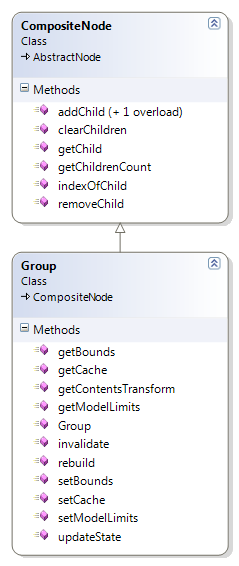
A composite node has a collection of children nodes. All children use inner coordinates of a composite node as the parent coordinates. A child node has a reference to its parent. The picture below shows its schematic class diagram.
# Architecture
CompositeNode has methods to add and delete children nodes:
- The
addChildmethod adds a child node. - The
clearChildrenmethod clears a collection of children. - The
getChildmethod returns a child from the given index. - The
getChildrenCountmethod returns a count of children. - The
indexOfChildmethod returns a child index. - The
removeChildmethod removes a child from a collection.
A Group extends CompositeNode and it has the following methods:
- The
getCacheandsetCachemethods get and set a cache strategy. A cache is a strategy how a group and its children can be rendered into raster cache. It is a different between cache and state. A cache is a raster and state is vector cache. - The overridden
getBoundsandsetBoundsmethods get /set bounds of the group in the parent coordinates. - The
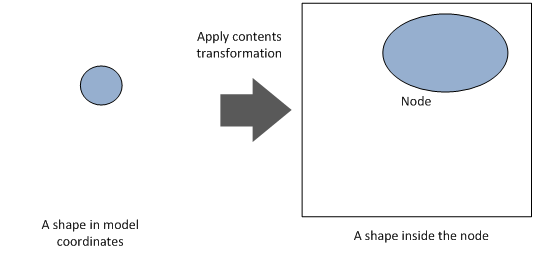
getContentsTransformmethod returns the affine transformation from inner model coordinates to the node bounds. If the node does not have its own model limits (getModelLimits()returns null) thengetContentsTransformreturns the identity transformation.
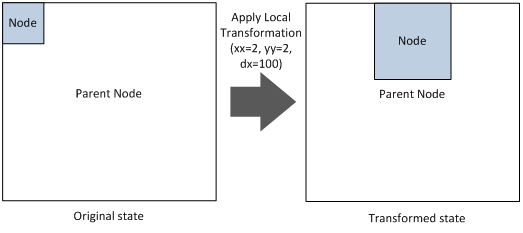
- The nodes bounds can be additionally transformed in the parent’s coordinate system, i.e. scaled, translated or rotated. Instead of changing bounds directly, an additional transformation is used, which defines how the nodes bounds can be transformed into the parent. The
getLocalTransformmethod returns this transformation. The figure below shows a process of local transformation.